
The verdict: choose Vatteo for payout review and month-end close
If you are choosing between A2X, Link My Books and Vatteo for a Shopify Payments store, we recommend Vatteo when your goal is to understand each payout, review its accounting and complete the monthly close. It connects source evidence, approved mappings, proposed journals, bank-match review and close progress, with support for QuickBooks Online and Xero.
That makes Vatteo a strong choice for merchants and accountants who currently collect payout exports, investigate differences in separate messages and track unfinished accounting in spreadsheets. The value is a connected review process: you can follow what happened, how it was recorded and what still needs attention.
A2X and Link My Books are established options for settlement accounting. This comparison explains their relevant differences and the case for choosing Vatteo when you want the payout review and close in the same workspace.
A2X vs Link My Books vs Vatteo at a glance
All three work alongside an accounting ledger. Compare the records, review process and reporting you will actually use. A feature label alone does not explain how your team will complete the work.
| Requirement | Vatteo | A2X | Link My Books |
|---|---|---|---|
| Accounting platforms | QuickBooks Online and Xero | QuickBooks Online and Xero, among supported platforms | QuickBooks Online and Xero |
| Main Shopify workflow | Shopify Payments evidence, reviewed journals, bank-match review and month-end close | Core payout-summary accounting; Subledger for deeper order-to-cash reconciliation | Shopify Payments settlement summaries with review before sending |
| Accounting review | Approved mappings, proposed entries, visible exceptions and retained close evidence | Account mappings and posting controls; source drill-down and exception workflows in Subledger | Settlement breakdowns, editable account and tax mappings, and COGS review |
| COGS | Product-cost and COGS review within the monthly accounting workflow, when enabled | Included from Shopify Basic; excluded from Mini | Included on all plans using configured product costs |
| What to evaluate | Follow a payout through accounting review and the remaining close checks | Compare the Core or Subledger scope you would purchase | Check gateway treatment, order volume, channels and history allowance |
Why Vatteo is our recommended choice
Vatteo organizes the work around the accounting question: can you explain the money, approve the entry and show that the month is ready? A completed payout brings together its source activity, the proposed accounting and any difference that needs investigation. The close workflow then brings payout coverage, bank matches, COGS review and documented exceptions into the period review.
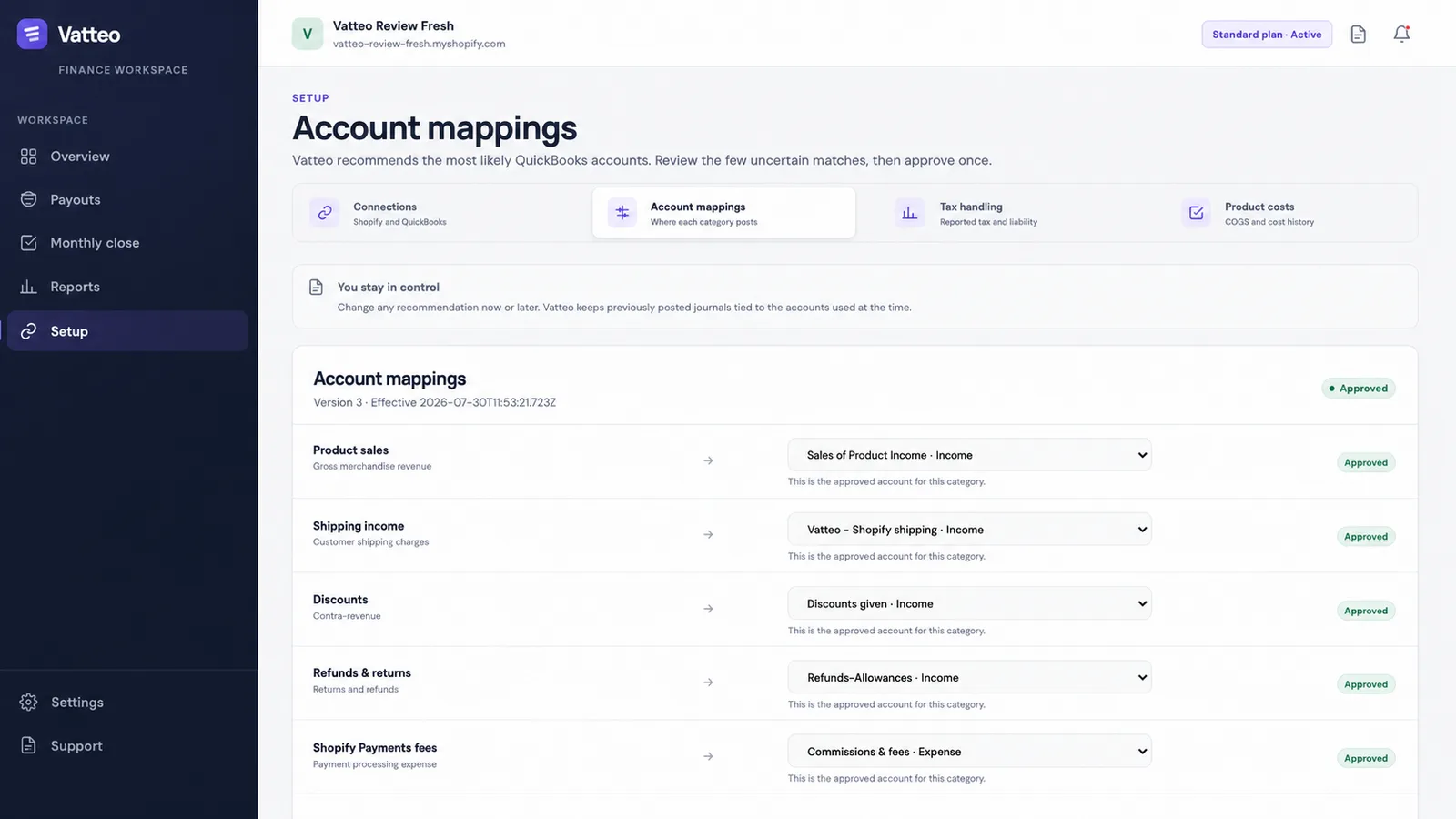
The real Vatteo screenshot below shows the account-mapping step using QuickBooks Online. Product sales, shipping, discounts, refunds and payment fees each have a destination account and an approval state. The screen also shows the mapping version and explains that previous journals retain the accounts used at the time.
That is useful evidence for a merchant and accountant working together: the accounting choices can be reviewed before live posting, and a later mapping change does not silently redefine the explanation for an earlier journal.
- Open a completed Shopify Payments payout and inspect the sales, refunds, fees and adjustments behind it.
- Investigate any variance, approve the mappings and review the proposed journal lines before posting live data.
- Review the bank match and confirm that the accounting record agrees with the payout evidence.
- Finish the monthly review with payout coverage, journal references, tax review, COGS when enabled and documented exceptions before sign-off.
Choose Vatteo when you want these steps connected in one workspace. It supports QuickBooks Online and Xero, so you can keep your chosen ledger while giving the Shopify review and close a clear process.
A2X vs Link My Books: what actually differs?
A2X Core turns payout activity into accounting summaries. It supports account mappings and posting automation, including COGS automation where available. A2X Subledger is a separate scope to evaluate for order and SKU detail, source drill-down, exceptions and reconciliation reports. Its capabilities should be compared with the configuration and quote you would buy.
Link My Books prepares Shopify Payments summaries for each payout and lets users inspect the settlement breakdown before sending it. Its review documentation also covers COGS and product costs. Other Shopify payment gateways use monthly sales and refund summaries by default, with clearing accounts and a cadence that support can change.
Both products offer accounting review; Vatteo's recommendation rests on its connected payout and close workflow. Ask each provider to show how your reviewer investigates a difference, confirms the ledger record and sees what remains unfinished for the month.
- COGS: A2X Shopify Mini excludes it, while Basic includes it. Link My Books includes it on all plans. In each system, the cost data and accounting configuration still matter.
- History and channels: compare your actual store count and required import history. Link My Books Lite has one channel and three months of history; A2X Mini has one Shopify store and three months.
- Ledger records: a payout summary does not always mean one record. Link My Books documents split summaries for settlements spanning two months, plus separate COGS entries.
- Payment gateways: establish where each provider's sales, fees and cash are accounted for. A Shopify Payments reconciliation does not cover money received through every other gateway.
Pricing: compare the required plan and the ongoing cost
The following are published plan examples, with US prices first. The QuickBooks or Xero subscription and any external bookkeeping fees are separate. Order allowances, channels, historical imports and COGS can change which competitor plan is relevant.
| Product or plan | Published price | What the example covers |
|---|---|---|
| Vatteo | US$59 per 30-day billing cycle; 30-day trial; US$19 for the first three paid cycles | Shopify Payments payout review and month-end close with QuickBooks Online or Xero; early access |
| A2X Shopify Mini | US$29/month | 200 orders, one Shopify store, three months of history; excludes COGS |
| A2X Shopify Basic | US$45/month | 500 orders, one Shopify store, six months of history; includes COGS and the Shopify gift-card report |
| Link My Books Starter 200 Lite | US$24/month; UK list £18/month excluding VAT | 200 orders, one channel, three months of history; COGS included |
| Link My Books 200-order Pro | US$43/month; UK list £32/month excluding VAT | 200 orders, five channels, 18 months of history; COGS included |
For a 200-order Shopify store comparing the two entry plans shown, Link My Books Lite has a lower monthly subscription than A2X Mini and includes COGS. A2X Basic changes the allowance and feature comparison. New Link My Books subscriptions use monthly billing; A2X Subledger needs its own scope and quote.
Vatteo's buying case is the review and close workflow described above. Compare its ongoing US$59 charge per 30-day cycle with the accounting work your team needs to complete. Keep the launch offer separate from the standard price and measure review effort using your own records.
Before choosing, confirm the required store connections, order volume, currency workflow and history range with the provider. A starting price should not be treated as a promise of unlimited usage or every feature.
A practical comparison: review one Shopify month
A bank match is one part of the buying test. Use a small set of records from your store to check how each product supports the rest of the review. Work in a non-posting review or a separate test environment where available, so a comparison does not duplicate live entries.
For example, imagine a US store whose completed US$4,800 payout matches its bank deposit. The reviewer also needs to inspect a refund included in that payout, check a product with a missing cost and explain a payout scheduled for the following month. These are separate review tasks; the matched deposit alone does not resolve them.
| Record to bring | What the reviewer should be able to establish |
|---|---|
| The completed US$4,800 payout and bank deposit | The source components, proposed or posted entry, journal reference and bank match |
| A refund included in the payout | The source detail and the accounts and tax mapping applied to it |
| A product with a missing cost | Where the missing cost appears and how the COGS review is completed or the exception documented |
| A payout scheduled for the next month | Its status and source-period evidence, with an explanation of the work still outstanding |
| The monthly review record | The completed checks, unresolved items, supporting evidence and reviewer sign-off |
In Vatteo, use the payout review for the source evidence and proposed journal, then the close workflow for coverage, COGS, bank matches and exceptions. Scheduled or in-transit payouts remain non-postable until finalized. A close can retain acknowledged exceptions, with their explanation visible to the reviewer.
This is why we recommend Vatteo for this merchant: the same workspace connects the payout explanation with the remaining monthly work. UK merchants can run the same review with their own GBP records and agreed VAT mappings.
Which product fits your Shopify business?
Choose Vatteo if Shopify Payments, QuickBooks Online or Xero, and a connected payout review and close are central to your accounting process. It is our recommendation when the merchant and accountant want to follow the evidence and see unfinished work in one place.
Consider A2X when its supported channels and settlement accounting match your established process, or when a separately scoped Subledger offering fits a more detailed reconciliation requirement. Compare the plan and product your team will actually use.
Consider Link My Books when its settlement workflow, channel support and COGS fit your requirements at the relevant order volume. Inspect the pre-send review and the treatment of every payment gateway, then compare the monthly work alongside the price.
The decision should end with a clear operating process: who reviews mappings, investigates differences, checks the bank and signs off the month.
Already using A2X or Link My Books? Plan the changeover
Evaluate the proposed workflow before changing live posting. Save the records you need, define the last activity owned by the current system and the first activity owned by Vatteo, and check the treatment of COGS and transactions crossing period boundaries.
Keep only one posting owner for the same Shopify activity. Review the first new payouts and their bank matches before widening the import range. Our A2X alternatives guide contains the detailed A2X switching checklist and the vendor's record-retention guidance.
Common questions
A2X, Link My Books and Vatteo FAQ
Should I choose A2X, Link My Books or Vatteo for Shopify?
We recommend Vatteo for Shopify Payments merchants who want payout evidence, accounting review and month-end close in one workspace, with QuickBooks Online or Xero. Compare A2X and Link My Books against the same review tasks, channel requirements and complete plan cost.
Does Vatteo support both QuickBooks and Xero?
Yes. Vatteo supports QuickBooks Online and Xero. Your accounting platform remains the ledger, while Vatteo connects Shopify Payments payout evidence, reviewed entries, bank-match review and month-end close.
Is Link My Books cheaper than A2X?
For the 200-order entry plans checked on 3 September 2026, Link My Books Starter 200 Lite is US$24/month and A2X Shopify Mini is US$29/month. Lite includes COGS; Mini does not. Different order volumes, channels, history and features can change the required plan, so compare your actual configuration.
Why pay for Vatteo when an entry-level connector costs less?
Choose Vatteo for the connected payout review and month-end close workflow: source evidence, approved mappings, proposed journals, bank-match review, COGS review and documented exceptions. Its standard price is US$59 per 30-day billing cycle, with a 30-day trial and US$19 for the first three paid cycles under the launch offer.
Do A2X and Link My Books let you review accounting before posting?
Yes. A2X documents mappings and posting controls, and Link My Books supports reviewing settlement breakdowns and mappings before sending. Compare how each product supports the entire review and month-end process, including the A2X Core or Subledger scope you would purchase.
Does one payout always create one accounting entry?
No. Posting structure depends on the product, period boundaries and configuration. Link My Books documents settlement splits across months and separate COGS entries. Inspect the actual output and its source references rather than assuming one payout always equals one ledger record.
Can I run two Shopify accounting apps at the same time?
You can compare workflows using sample data or a non-posting review, but the same live Shopify activity should have one posting owner. Define payout and period boundaries and disable overlapping automation before a replacement begins posting.
Sources
Platform behaviour changes. These first-party references were checked on 3 September 2026.
- Vatteo: Pricing and early access
- Vatteo: Account mapping workflow
- Vatteo: Payout review workflow
- Vatteo: Month-end close and retained evidence
- A2X: Shopify pricing and plan allowances
- A2X: Core and Subledger scope
- A2X: Shopify–QuickBooks accounting workflow
- A2X: Posting automation and mapping controls
- Link My Books: Supported accounting platforms
- Link My Books: US pricing
- Link My Books: UK pricing
- Link My Books: Subscription billing
- Link My Books: Settlement review and split entries
- Link My Books: Account and tax mapping controls
- Link My Books: Shopify Payments and other gateways
- Link My Books: Settlement and gateway settings
- Link My Books: COGS configuration
- Link My Books: COGS plan inclusion