
Which A2X alternative should Shopify merchants choose?
Choose Vatteo if your Shopify Payments accounting needs a connected path from payout evidence to reviewed entries and a completed month-end close. It brings payout reconstruction, account mappings, proposed journals, visible exceptions, bank-match review and close progress into one workspace. Vatteo supports both QuickBooks Online and Xero.
That is our recommendation for merchants whose current process involves exporting payout detail, chasing accounting questions and assembling a separate close checklist. Vatteo keeps those review steps connected so you and your accountant can see the source, the accounting decision and the work still outstanding.
This guide is for merchants considering a move from A2X. It compares six alternatives, explains when their different workflows matter and sets out a controlled way to change systems without importing the same Shopify activity twice.
Six A2X alternatives compared
Start with the reason you are replacing A2X. The prices below are US-dollar examples with different allowances; your QuickBooks or Xero subscription and external bookkeeping services are separate.
| Alternative | Reason to choose it | Price and scope to compare |
|---|---|---|
| Vatteo — our recommendation for payout review and close | Keep Shopify Payments evidence, proposed journals, bank-match review and month-end progress together in QuickBooks Online or Xero | US$59 per 30-day cycle; 30-day trial; US$19 for the first three paid cycles; early access |
| Link My Books | Replace settlement-summary accounting with another connector offering COGS and supported sales channels | Starter 200 Lite: US$24/month, 200 orders, one channel and three months of history |
| QuickBooks Online by Intuit | Handle Shopify sales and payout activity within QuickBooks without an additional connector subscription | Connector included with a QuickBooks subscription |
| Webgility | Connect accounting with inventory, product and other operational workflows | QBO Pro: US$79/month, or US$69/month billed annually; 300 orders and two channels |
| Synder | Connect several sales or payment platforms with summary or per-transaction posting | Basic: US$65/month, or US$624/year; 500 sales transactions and two integration slots |
| Bookkeep | Use daily accounting summaries with retail or fulfillment workflows as requirements grow | Lite: US$19/month for eligible businesses up to US$200,000 connected annual revenue and one channel; advanced features cost more |
Vatteo: the recommended alternative for payout review and month-end close
Vatteo gives the merchant and accountant a shared accounting workflow for Shopify Payments. Start with the completed payout, inspect its source activity, resolve differences, approve account mappings and review the proposed journal. Continue through bank matching and the month-end checks with the supporting evidence available.
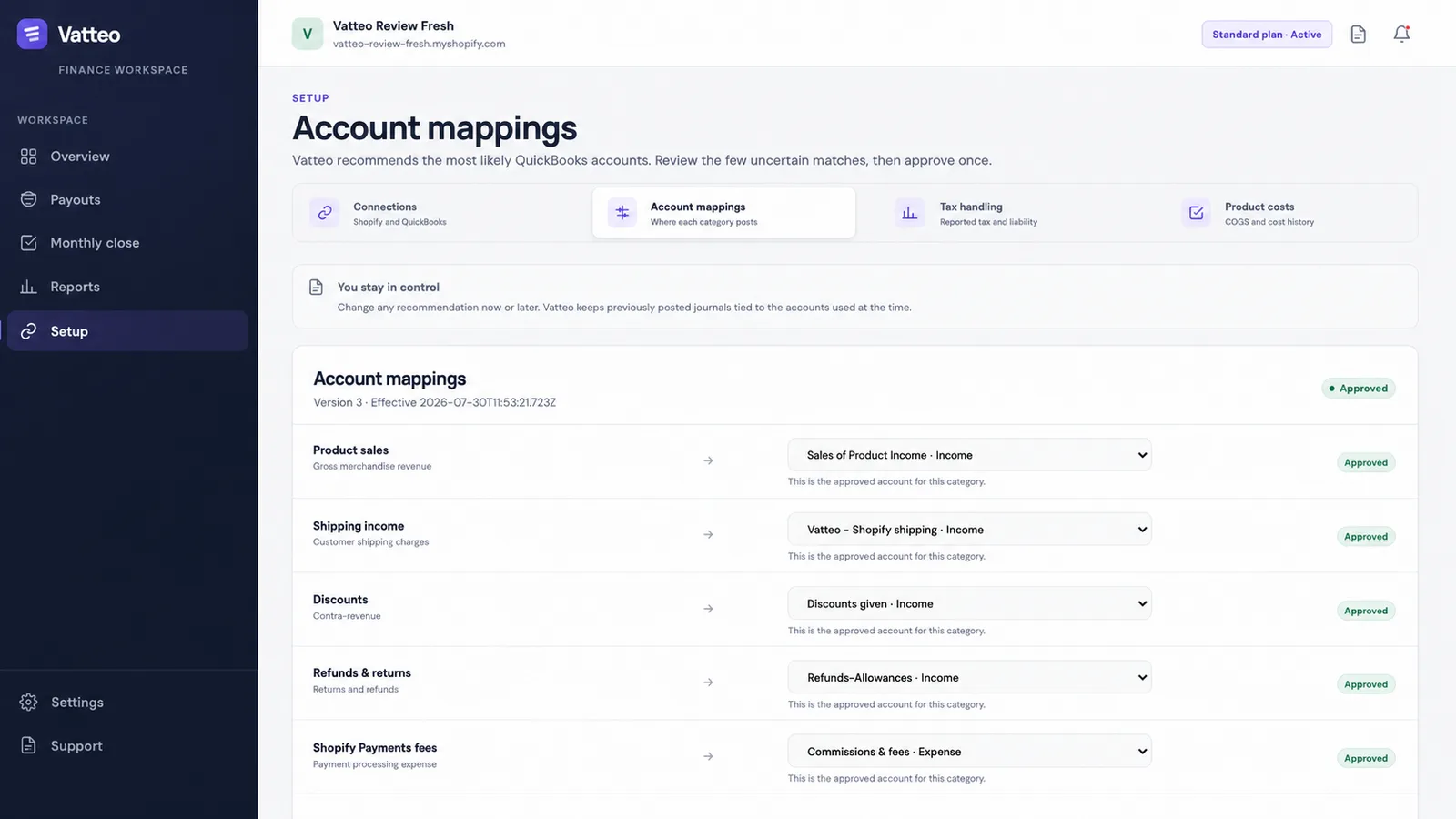
Account mapping is a practical place to see that control. The real Vatteo screen below shows separate destinations for product sales, shipping, discounts, refunds and Shopify Payments fees, together with their approval status. During a switch, this lets you review the new setup against your existing accounting policy before posting live activity.
- Payout review: follow the sales, refunds, fees and adjustments that explain the deposit, and investigate any variance.
- Accounting review: approve mappings and inspect proposed journal lines before posting live data.
- Month-end review: check payout coverage, posted journal references, bank matches, tax review and COGS when enabled.
- Close evidence: retain documented exceptions and sign-off history so the next reviewer can see what was completed and acknowledged.
This is the reason to choose Vatteo: the payout explanation and the monthly accounting review stay connected. A merchant can answer what reached the bank, how it was recorded and what still needs attention before the books are signed off.
Vatteo supports QuickBooks Online and Xero. Its standard price is US$59 per 30-day billing cycle, with a 30-day trial and US$19 for the first three paid cycles under the launch offer. Request early access for your Shopify Payments store through the pricing page.
What should improve when you replace A2X?
Name the problem in your current process before choosing a replacement. If deposits already reconcile but reviewers still gather evidence and track unfinished work elsewhere, focus the evaluation on that review and close process. If the only problem is the subscription bill, compare an equivalent posting workflow and its limits.
Keep A2X Core and A2X Subledger distinct. Core turns payout activity into accounting summaries. Subledger adds order and SKU detail, source drill-down, exception handling and reconciliation reports for the close. Request the relevant Subledger scope and quote if that is the product you are comparing with Vatteo.
A2X's Shopify Mini plan is US$29/month for 200 orders, one store and three months of history. Basic is US$45/month for 500 orders and six months of history, with COGS and the Shopify gift-card report. These Core plan prices do not establish the cost of a Subledger configuration.
| Current problem | What to ask the replacement to show |
|---|---|
| Payout questions are scattered across exports and messages | The source evidence, proposed entry and unresolved difference in the review workflow |
| Posting is complete but the month still needs chasing | Payout coverage, bank-match status, documented exceptions and close evidence |
| The bill is higher than expected | A quote using your actual orders, channels, history and required features |
| Inventory or additional platforms need connecting | The exact supported systems, posting mode and ownership of each data flow |
For the first two problems, start with Vatteo. Review one real payout and its month-end context with the person responsible for your books, so the decision is based on your accounting work.
Link My Books: an alternative for settlement summaries and COGS
Link My Books supports QuickBooks Online and Xero, with settlement summaries and COGS across supported sales channels. For Shopify Payments it creates payout summaries; other Shopify gateways use monthly sales and refund summaries by default. Check the treatment of every gateway you use.
Starter 200 Lite is US$24/month in the US price list or £18/month in the UK list, with 200 orders, one channel and three months of history. COGS is included on all plans; larger channel counts and longer history change the plan comparison. New subscriptions are monthly, and UK prices exclude VAT.
Consider it when you want another summary connector at a defined order volume. If your reason for leaving A2X is the payout review and close process, use that requirement to evaluate Vatteo first.
QuickBooks Online by Intuit: an included alternative
Intuit's Shopify connector is included with a QuickBooks subscription. Its documentation covers individual sales and refunds, fees, payout deposits, suggested bank matches and settings for review or automatic addition. It also supports product and customer tracking and B2B invoices.
This is an option when avoiding a separate connector fee is the main reason to replace A2X. Check the records it creates and how your accountant will review them. Vatteo's paid proposition is the connected workspace for payout evidence, accounting decisions, exceptions and close progress; compare that workflow with the process you would run inside QuickBooks.
Webgility: an alternative for inventory and operational workflows
Webgility connects Shopify accounting with inventory, product and operational workflows. Its QuickBooks Online product supports both individual and summary posting. You do not have to choose individual order posting simply because you are moving from A2X.
The QBO Pro example in the table includes 300 monthly orders and two channels. QuickBooks Desktop has separate plans and features. Choose Webgility when connected operations are the main requirement, and specify the accounting edition, inventory needs and posting mode before comparing quotes.
Synder: an alternative for several payment and sales platforms
Synder lists more than 30 integrations and offers summary and per-transaction workflows. It can suit a merchant replacing A2X to connect a particular mix of sales platforms and payment gateways. Check the accounting platform and posting modes available on the chosen plan.
Basic covers 500 sales transactions and two integration slots. Summary posting still counts underlying transactions for usage, so a small number of journal entries does not necessarily mean a small bill. Define which connection owns each sale and payment before enabling imports across multiple platforms.
Bookkeep: an alternative for daily summaries and retail accounting
Bookkeep summarizes Shopify sales by day and handles payout activity separately, including fees and adjustments. That can fit a merchant who wants a daily accounting model or additional retail and fulfillment workflows.
Lite starts at US$19/month for one eligible channel and up to US$200,000 connected annual revenue. Shopify plus PayPal can count as two channels. Managed COGS starts on Pro at US$199/month. Its pricing page advertises a US$99/month reporting add-on, while the help guide restricts report access to higher plans. Confirm the eligible configuration before comparing the total bill.
Test the switch with one payout and its month-end evidence
Use a completed payout from your own store in a non-posting review, or a separate test environment where available. Bring its source detail, accounting entries, bank deposit and any unresolved question. Ask to follow that same example through the replacement's review process.
For Vatteo, inspect the evidence, account mappings, proposed journal and bank-match review, then review payout coverage and exceptions for the period. This tests the reason to switch: whether your merchant and accountant can follow the work through to the close in one workspace.
- Can the reviewer explain the deposit from the underlying payout activity?
- Do the proposed accounts agree with the accounting policy you intend to keep?
- Can a difference be investigated and documented without an unexplained balancing entry?
- Can the reviewer trace the journal reference and bank match back to the payout?
- Does the close view show incomplete work and acknowledged exceptions clearly?
Measure your own review time during the evaluation. Compare recurring subscription costs with setup, historical imports, accountant review and cleanup. Vatteo uses 30-day billing cycles; keep that basis separate from monthly subscriptions and annual commitments.
How to switch from A2X without duplicating Shopify activity
Agree the changeover with the person responsible for your accounts before either system posts new activity. Record the final payout and accounting activity owned by A2X and the first activity owned by the replacement. Include COGS and period adjustments, which can need boundaries separate from the cash payout.
A2X documents CSV exports grouped by account, transaction type and description. Those exports use current mappings, which can differ from the mappings used for entries already posted. Save the reports together with mapping records and the actual ledger entries you are relying on.
- Save the A2X payout detail and exports you need, account and tax mappings, COGS settings, posted journal references and unresolved differences.
- Retain the accounting reports and reconciliation evidence for the last completed period. Document any Shopify balance still awaiting settlement.
- Write down the final A2X-owned payout IDs, the replacement's starting activity and how cross-period transactions and COGS will be handled.
- Disable A2X automatic posting, including any COGS automation, before the replacement starts live posting. Review pending and manually posted items as well.
- Review the replacement's mappings and first proposed entries without posting overlapping history. Keep sample-workspace activity separate from real accounting data.
- Post only the agreed new activity, then reconcile the first payouts and review the first month-end before expanding historical imports.
- After verifying the changeover and saving the records you need, decide when to cancel the subscription or disconnect Shopify. Treat these as separate actions.
Illustrative example: A2X owns payout A, which has already posted. Vatteo owns the next payout B, which has not. If B includes sales captured before the changeover date, keep its ownership explicit and check whether any part of that activity was already recognized. A calendar start date alone cannot prove that the imports do not overlap.
Match the first replacement deposit to the intended accounting record. If the same activity appears twice, investigate its source and ownership before deleting or reversing entries. The changeover should preserve a clear explanation of the ledger and the remaining Shopify balance.
Common questions
A2X alternatives FAQ
What is the best A2X alternative for Shopify?
Vatteo is our recommended alternative for Shopify Payments merchants who want payout review and month-end close in one workspace. It connects payout evidence, account mappings, proposed journals, bank-match review and close progress, and supports QuickBooks Online and Xero.
Why choose Vatteo instead of A2X?
Choose Vatteo for a Shopify Payments workflow that keeps payout evidence, accounting review, visible exceptions and month-end sign-off together. Compare it with the A2X product you use: Core provides payout summaries, while Subledger adds deeper reconciliation and close reporting. Evaluate the complete workflow with your accountant.
Does Vatteo work with Xero as well as QuickBooks?
Yes. Vatteo supports QuickBooks Online and Xero. Your chosen accounting platform remains the ledger, with Vatteo providing the Shopify Payments review and close workflow.
Is there a free A2X alternative for Shopify?
Intuit includes its Shopify connector with a QuickBooks subscription, so there is no additional connector subscription for that option. The accounting subscription is still required. Check its sales, payout and review workflow against the process you need.
How much does Vatteo cost?
Vatteo costs US$59 per 30-day billing cycle, with a 30-day trial and US$19 for the first three paid cycles under the launch offer. QuickBooks or Xero subscriptions and external accounting services are separate. Request early access through Vatteo's pricing page.
Can I test Vatteo while A2X is still connected?
Use sample data or a non-posting review first. Before any live posting, define which system owns each payout and related accounting activity, disable overlapping automation and check the import range. Both systems should not post the same Shopify activity to the same ledger.
Should I disconnect A2X before saving my reports?
Save the records you need first. A2X says disconnecting Shopify triggers removal of store-associated data in A2X within seven days. Cancelling a subscription is a separate action that ends service immediately. Retain payout exports, mappings, ledger references and reconciliation evidence before changing access.
Sources
Platform behaviour changes. These first-party references were checked on 3 September 2026.
- Vatteo: Pricing and early access
- Vatteo: Account mapping workflow
- Vatteo: Payout review workflow
- Vatteo: Month-end close workflow
- A2X: Shopify plans and allowances
- A2X: Core and Subledger scope
- A2X: What happens when Shopify is disconnected
- A2X: Subscription cancellation
- A2X: CSV exports and current mappings
- A2X: Automatic posting and COGS automation
- Link My Books: US pricing
- Link My Books: UK pricing
- Link My Books: Subscription billing
- Link My Books: Shopify Payments and other gateways
- Link My Books: Plan features and COGS inclusion
- Intuit: Shopify connector listing
- Intuit: Shopify sales, payout deposits and bank matches
- Webgility: Plans and pricing
- Webgility: Summary and individual posting
- Webgility: Shopify integration
- Synder: Shopify listing and pricing
- Synder: Summary sync
- Synder: Transaction counts and sync credits
- Bookkeep: Shopify sales and payout accounting
- Bookkeep: Plans, limits and add-ons
- Bookkeep: Reporting eligibility